Tuesday, 3 March 2020

Update Semester 2 (5 April update)

Reading and (Changed) Dates of the Manchester Phenomenology Reading Group 2019-2020


Meetings: Wednesdays 5-6.30 pm BY ZOOM (please contact Alex to receive an invite)

New Date: 22 April (dates thereafter to be decided)


Reading for meeting Wednesday 22 April  2020

Jean-Luc Nancy, The Ground of the Image (translated by Jeff Fort) New York: Fordham University Press, 2005, Chapter 3 (Forbidden Representation, pp. 27–50)

Saturday, 26 October 2019

Update October 2019


Our next two texts this Semester are:

30 October 2019

(1) The Age of the World Picture,

in e.g. Heidegger, The Question Concerning Technology and Other Essays, trans. William Lovitt (NY: Harper and Row, 1977), pp. 115–154; there are also other translations into English
Die Zeit des Weltbildes, in Heidegger, Holzwege, 7th edn. (Frankfurt: Klostermann, 1994; original 1950), pp. 75–95 (Zusätze, pp. 96–113).

13 November 2019 (or later)

(2) The Question Concerning Technology,

in Lovitt (above), pp. 3–35, also in Krell's translation in Heidegger, Basic Writings, expanded edn (London: Routledge, 1993), pp. 307–342.
Die Frage nach der Technik, in Heidegger, Vorträge und Aufsätze, 8th edn (Stuttgart: Neske, 1997; original 1954), pp. 9–40; also in a separate publication together with "die Kehre", Neske 1962. 

Tuesday, 17 September 2019

Academic Year 2019–2020

Academic Year 2019–2020
Phenomenological Engagements with Art
Nancy
We plan to read:
1. Heidegger, 'The Origin of the Work of Art', in Holzwege and elshere, translated in Albert Hofstadter, trans., Poetry, Language, Thought (New York: Harper & Row, 1971), and elsewhere
2. Heidegger, “The Age of the World Picture”, in The Question concerning Technology and Other Essays, (translated and with an Introduction by William Lovitt) London: Harper and Row, 1977,pp. 115–145
3. Heidegger, 'The Question Concerning Technology' (1954), e.g. in Lovitt
4. ‘The Thing’, in Hofstadter pp. 161–184     (or, 'The Turn', to be decided)        
5.  Levinas, 'Reality and its Shadow' (1948), in Seán Hand, ed., The Levinas Reader, Oxford: Basil Blackwell, 1989, pp. 129-143 including Hand's introduction; cp. Aaron Rosen's article, "Emmanuel Levinas and Hospitality of Images", in Literature and Theology, Vol. 25. No. 4, December 2011, pp. 364-378) 
6. Jean-Luc Nancy, The Ground of the Image (translated by Jeff Fort) New York: Fordham University Press, 2005.
 Heidegger
In Semester 1 we plan to meet on Wednesdays at 5 pm on:


18 Sept
2 Oct
16 Oct
30 Oct
13 Nov
27 Nov
11 Dec
Venue: Seminar Room 1, Graduate School Manchester University, Ellen Wilkinson Building Section C; campus map building 77; https://www.manchester.ac.uk/discover/maps/interactive-map/ 
Blanchot and Levinas

Friday, 4 January 2019

Gadamer, Truth and Method, Semester 2

Semester 2 Meeting schedule (to be confirmed):


30 January 2019
13 Feb
27 Feb
13 March
27 March (followed by the Manchester Easter lecture break beginning the week after)
1 May
15 May (For venue, details and times, see below)

Saturday, 22 September 2018

New Text 2018–19


Reading Gadamer, Truth and Method   


Semester 1 information: 
Wednesdays 5–6.30, fortnightly (except for the first two meetings)
First meeting: 26 Sept  2018 

Thereafter: 3 October (only one week), 17 October, 31 Oct, 14 Nov, 28 Nov, 12 December.

Venue: Seminar room 1 on the ground floor of the SALC Graduate School (Ellen Wilkinson Building part C, campus map 77). 
Text for the first two meetings:  English trans.: Gadamer's Introduction (pp. xx to xxiv in the English) and first sub-section (pp. 1–37). 
Open to University staff, current University graduate or research students, General public
Everybody welcome, but please let Alex Samely know you are coming: alex.samely@manchester.ac.uk


Gadamer’s Truth and Method (1960) is one of the key critiques of historical, literary and art-related scholarship of the 20th century. We will read the book in instalments over the academic year, meeting mostly fortnightly on Wednesdays at 5pm. We will discuss its philosophical, aesthetic, phenomenological and historical implications, and compare it to some extent with the positions of other thinkers, including Heidegger and Benjamin. The Semester 1 dates are: 26 Sept, 3 October, 17 October, 31 Oct, 14 Nov, 28 Nov, 12 December. We meet in Seminar room 1 on the ground floor of the SALC Graduate School (Ellen Wilkinson Building part C). Segment for the first two meetings: Introduction and first sub-section (pp. 1–37) in the English translation (second edn., by Weinsheimer and Marshall; London: Continuum, 2004). No knowledge of German necessary, although some group members will use the German original.


Wednesday, 6 September 2017

2018 schedule: Heidegger after Being and Time

The Manchester Phenomenology Reading Group returns to Heidegger in the academic year (2017-2018).

Semester 2:
The new Semester's meetings will be:
Wed 31 Jan
Wed 14 Feb
Wed 28 Feb
Wed 7 March [NOTE ONLY ONE WEEK GAP]
Wed 21 March
Wed 18 April
Wed 2 May
Wed 16 May

We will complete the final lectures of Was heisst Denken? on 31 January, before making the transition to The Principle of Reason (some details below). We meet in the same room as before.


Earlier, Semester 1:


The first meeting is dedicated to Heidegger's Letter on Humanism (see links for pdf below) and it will be held in Room 1 of the SALC Graduate School at 5 pm on Wednesday 27 September. The room is marked as CG 59 of the Ellen Wilkinson Building, that is, it is to be found on the ground floor of the North-Easterly C-part of the building. The Graduate School's entrance is opposite to the South entrance of the Humanities building. Please try to read the text before the meeting.


Meetings are fortnightly, always at 5 pm on Wednesday. Here is the complete list of dates for the Autumn term:

Wed 27 September
Wed 11 October
Wed 25 October 
Wed 8 November 
Wed 22 November 
Wed 6 December 

There is a possibility for an additional meeting before the Winter break which will be confirmed later.

Readings are:

1. Heidegger, Letter on Humanism (English and German here attached)

2. Heidegger, What is Called Thinking? (trans. Gray, 1972, in our Library Blue Area Floor 3 (111.1 H98) = Was heisst Denken?, [in our library currently: Floor 3 (109.439 H106 )

3. Heidegger, The Principle of Reason, English: on order for the library; German: Der Satz vom Grund, ed. P. Jaeger, in our library currently in Store (109.439 H106 )

We may fit in at some point Nancy's article "Heidegger's originary ethics". 

What is Called Thinking? and The Principle of Reason are lecture series which Heidegger gave after the war and then published in the 1950s. For each book, there are two German editions available: the original (Neske, Pfullingen; Niemeyer, Tübingen ) and a one volume each of the Gesamtausgabe (Klostermann, Frankfurt); there are almost no differences in the text between the two versions. There are some additional comments in the latter, which Alex Samely possesses and he is happy share. 

Resources:

Was heisst Denken (in German) and What is Called Thinking (in English); Nancy "Heidegger's Originary Ethics"

There is no trace of a pdf copy of The Principle of Reason (Indiana UP, in press) or its German original on the Internet, so you may have to buy a copy (Library has one copy or will have, see above).


Friday, 30 September 2016

Notes on Descartes, Meditations I and II - Wednesday, 28 September 2016

Descartes, Meditations - Letter to the Sorbonne, Preface to the reader, Synopsis and the first two meditations (pp. 1-34)

Wednesday, 28 September 2016 (notes by Caroline Kaye and Marton Ribary)

Page numbers in Descartes refer to the marginal page numbers corresponding with the first edition.

The goal of the Meditations

The Letter to the Sorbonne claims that the Meditations shall provide evidence for the existence of God and the immortality of the soul. The goals Descartes announces here are extremely traditional, and they do not correspond to what actually happens in the Meditations. Birsen Dönmez (BD) pointed out that Descartes changed the title of the Meditations from the first edition which expected to secure the endorsement of the Sorbonne. As Descartes was unsuccessful in securing that, he must have felt that the scholastic disguise was no longer necessary.

Skepticism

Alex Samely (AS) asked whether it could be a ruse to undermine scepticism (itself). Can doubt in a measured way become a new anchor for knowledge? Leif suggested that it was a tool for establishing certainty, the acquisition of knowledge. Radical scepticism would make it impossible to function as one would not be able to trust anything, not even the ground beneath one’s feet. It was hotly debated whether the existence of the “I” was sufficiently demonstrated, or it was merely postulated as part of Descartes’ radical thought experiment. What is a proof, what is a mere proposition when radical scepticism gets rid of all assumptions which might be used for building an argument?

Descartes denies certainty from anything in the world. His senses can fool him, memory can lie. He needs to take everything back to a primordial point of certainty. How do we know that the world is not illusory? Knowledge of the world (if it exists!) comes via senses which are not reliable. “We must reject what they seem to teach us”[1]

Meditation

The use of the word “meditation” is meant to signify “a process of thought” as opposed to our more modern idea of clearing the mind of thought. (It is actually quite difficult to be conscious of oneself not thinking.) In a sense Descartes is taking the reader on a journey, and we are invited to “think along” with the meditator. The force of his argument only works, if the reader plays along. The chosen method in Descartes reflects the first person perspective of the project: the certainty of the “I” can only be established for one’s self.

Descartes attempts to strip back what can be known in order to establish a method of enquiry into knowing, effectively his own reconstruction of knowledge.[2] His eschewing of scholastic discourse makes the mediations more personal, and is according to Charles Taylor, an example of “radical reflexivity” where one “focuses not on the objects of one’s experience, but on oneself as experiencing it.”[3]

The certainty of the “I”

In the second meditation, Descartes tells his reader that he recognises “for certain” that “there is no certainty”. (24) Leif Jerram (LJ) drew our attention to a passage on p. 22 where Descartes says that: “So in future I must withhold my assent from these former beliefs just as carefully as I would from obvious falsehoods, if I want to discover any certainty”. A lively debate unfolded around a paragraph on p. 25 paraphrased below.

I can be certain that I am thinking. This satisfies me that I exist. I cannot be certain that you exist, or anything else for that matter. But I can be sure that my thinking means that I exist. I am because I am a thinking thing. We do not at this point have any definition of what this “thing” might be, or what the “I” actually consists of. The important point is that even if I am a puppet who has had thoughts inserted into it by a malevolent being (Not God), then this does not negate the thought or the thinker as it were, rather it proves existence because thinking is happening. I know I’m thinking, it is the only thing I am certain of.

We returned again and again to the concept of the “I”, or the “self”. It was stressed that at this point Descartes had not declared a position on what the “I” is at all. At this point, AS was keen to know whether anyone in the group was convinced by Descartes’s claim. And if not, how would one argue for it not being convincing? How would you demonstrate that Descartes is wrong? There then ensued a lively debate about whether or not the argument was convincing, or whether it was preferable to read on before making a judgement. AS felt that it was important to get this clear as there were implications around this for notions of being, what it means to “be”.

Marton Ribary (MR) and Bobby Silverman (BS) drew our attention to a related passage on page 27 where Descartes states that “thought; this alone is inseparable from me”. He further says that “And yet may it not perhaps be the case that these very things which I am supposing to be nothing, because they are unknown to me, are in reality identical with the ‘I’ of which I am aware? I do not know, and for the moment I shall not argue the point, since I can make judgements only about things which are known to me.”

The hidden temporal aspect

Descartes introduces a hidden temporal aspect when in the crucial passages on page 25 and 27 he says that the postulated malignant demon “will never bring it about that I am nothing so long as (quamdiu) I think that I am something” and that “I am, I exist – that is certain. But for how long (quandiu). For as long as I am thinking.” We may then ask whether certainty has a limitation, and it is only established as long as I think. If so, how does this relate to Descartes’ claim that unlike the body, the soul is indissoluble and imperishable. He acknowledges an intimate unity between the body and soul during one’s bodily existence, but he yet claims that only the unity is temporary, but the existence of the soul predates the body’s existence and it survives its dissolution.

Additional material: Philosopher Barry Smith on Descartes and Consciousness (BBC Radio 4, A History of Ideas, 17 April 2015)

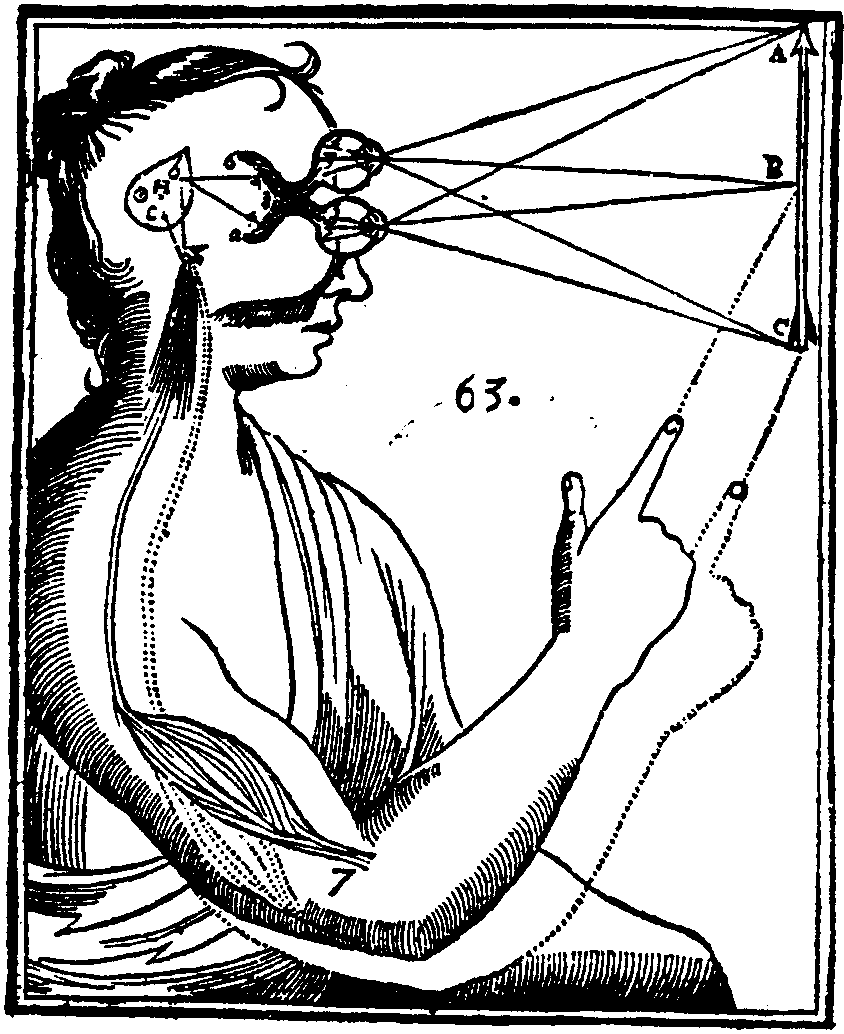
Image result for descartes

A diagram by Descartes in his optical treatise


[1] Michael Moriarty, Introduction, in Rene Descartes Meditations on First Philosophy (Oxford World’s Classics, OUP, 2008), xxv.
[2]Ibid., xiii.
[3] Ibid xxi.