Friday, 30 September 2016

Notes on Descartes, Meditations I and II - Wednesday, 28 September 2016

Descartes, Meditations - Letter to the Sorbonne, Preface to the reader, Synopsis and the first two meditations (pp. 1-34)

Wednesday, 28 September 2016 (notes by Caroline Kaye and Marton Ribary)

Page numbers in Descartes refer to the marginal page numbers corresponding with the first edition.

The goal of the Meditations

The Letter to the Sorbonne claims that the Meditations shall provide evidence for the existence of God and the immortality of the soul. The goals Descartes announces here are extremely traditional, and they do not correspond to what actually happens in the Meditations. Birsen Dönmez (BD) pointed out that Descartes changed the title of the Meditations from the first edition which expected to secure the endorsement of the Sorbonne. As Descartes was unsuccessful in securing that, he must have felt that the scholastic disguise was no longer necessary.

Skepticism

Alex Samely (AS) asked whether it could be a ruse to undermine scepticism (itself). Can doubt in a measured way become a new anchor for knowledge? Leif suggested that it was a tool for establishing certainty, the acquisition of knowledge. Radical scepticism would make it impossible to function as one would not be able to trust anything, not even the ground beneath one’s feet. It was hotly debated whether the existence of the “I” was sufficiently demonstrated, or it was merely postulated as part of Descartes’ radical thought experiment. What is a proof, what is a mere proposition when radical scepticism gets rid of all assumptions which might be used for building an argument?

Descartes denies certainty from anything in the world. His senses can fool him, memory can lie. He needs to take everything back to a primordial point of certainty. How do we know that the world is not illusory? Knowledge of the world (if it exists!) comes via senses which are not reliable. “We must reject what they seem to teach us”[1]

Meditation

The use of the word “meditation” is meant to signify “a process of thought” as opposed to our more modern idea of clearing the mind of thought. (It is actually quite difficult to be conscious of oneself not thinking.) In a sense Descartes is taking the reader on a journey, and we are invited to “think along” with the meditator. The force of his argument only works, if the reader plays along. The chosen method in Descartes reflects the first person perspective of the project: the certainty of the “I” can only be established for one’s self.

Descartes attempts to strip back what can be known in order to establish a method of enquiry into knowing, effectively his own reconstruction of knowledge.[2] His eschewing of scholastic discourse makes the mediations more personal, and is according to Charles Taylor, an example of “radical reflexivity” where one “focuses not on the objects of one’s experience, but on oneself as experiencing it.”[3]

The certainty of the “I”

In the second meditation, Descartes tells his reader that he recognises “for certain” that “there is no certainty”. (24) Leif Jerram (LJ) drew our attention to a passage on p. 22 where Descartes says that: “So in future I must withhold my assent from these former beliefs just as carefully as I would from obvious falsehoods, if I want to discover any certainty”. A lively debate unfolded around a paragraph on p. 25 paraphrased below.

I can be certain that I am thinking. This satisfies me that I exist. I cannot be certain that you exist, or anything else for that matter. But I can be sure that my thinking means that I exist. I am because I am a thinking thing. We do not at this point have any definition of what this “thing” might be, or what the “I” actually consists of. The important point is that even if I am a puppet who has had thoughts inserted into it by a malevolent being (Not God), then this does not negate the thought or the thinker as it were, rather it proves existence because thinking is happening. I know I’m thinking, it is the only thing I am certain of.

We returned again and again to the concept of the “I”, or the “self”. It was stressed that at this point Descartes had not declared a position on what the “I” is at all. At this point, AS was keen to know whether anyone in the group was convinced by Descartes’s claim. And if not, how would one argue for it not being convincing? How would you demonstrate that Descartes is wrong? There then ensued a lively debate about whether or not the argument was convincing, or whether it was preferable to read on before making a judgement. AS felt that it was important to get this clear as there were implications around this for notions of being, what it means to “be”.

Marton Ribary (MR) and Bobby Silverman (BS) drew our attention to a related passage on page 27 where Descartes states that “thought; this alone is inseparable from me”. He further says that “And yet may it not perhaps be the case that these very things which I am supposing to be nothing, because they are unknown to me, are in reality identical with the ‘I’ of which I am aware? I do not know, and for the moment I shall not argue the point, since I can make judgements only about things which are known to me.”

The hidden temporal aspect

Descartes introduces a hidden temporal aspect when in the crucial passages on page 25 and 27 he says that the postulated malignant demon “will never bring it about that I am nothing so long as (quamdiu) I think that I am something” and that “I am, I exist – that is certain. But for how long (quandiu). For as long as I am thinking.” We may then ask whether certainty has a limitation, and it is only established as long as I think. If so, how does this relate to Descartes’ claim that unlike the body, the soul is indissoluble and imperishable. He acknowledges an intimate unity between the body and soul during one’s bodily existence, but he yet claims that only the unity is temporary, but the existence of the soul predates the body’s existence and it survives its dissolution.

Additional material: Philosopher Barry Smith on Descartes and Consciousness (BBC Radio 4, A History of Ideas, 17 April 2015)
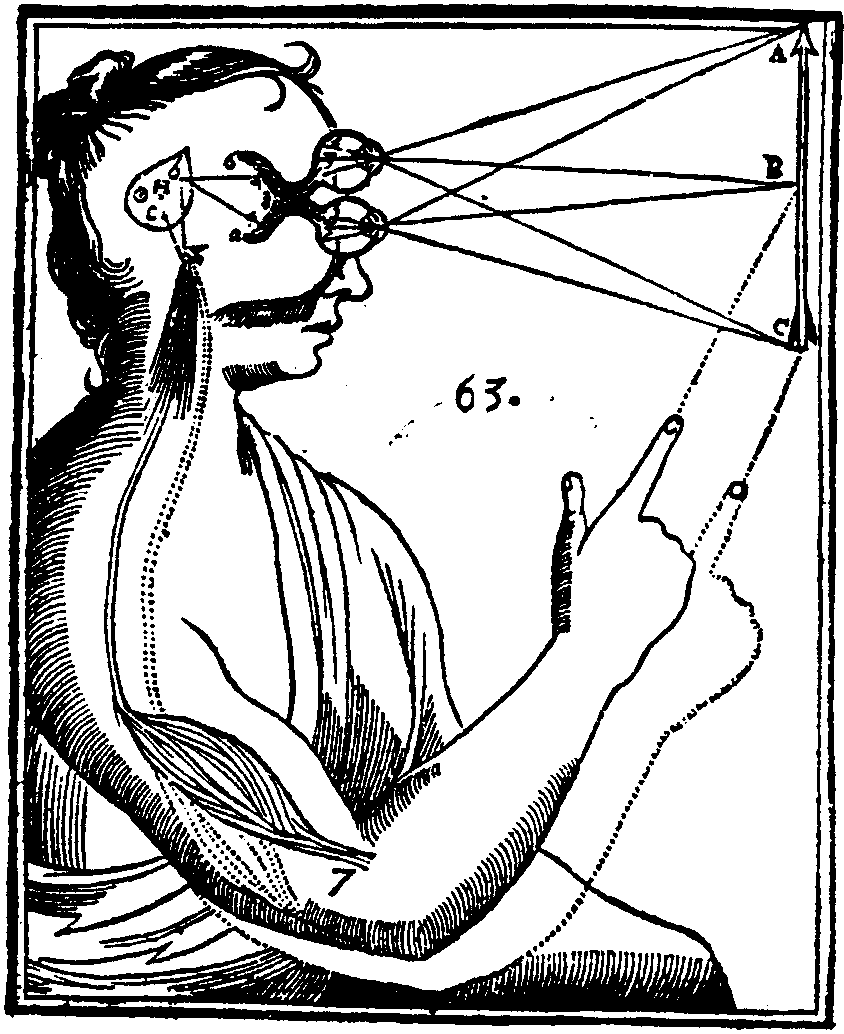
Image result for descartes

A diagram by Descartes in his optical treatise


[1] Michael Moriarty, Introduction, in Rene Descartes Meditations on First Philosophy (Oxford World’s Classics, OUP, 2008), xxv.
[2]Ibid., xiii.
[3] Ibid xxi.

Friday, 26 August 2016

The Meditations by Descartes, Husserl and Nancy

The Meditations by Descartes, Husserl and Nancy
Phenomenology Reading Group, 2016-2017
Wednesday 5pm, fortnightly
Venue: Please check the dates below

First session:

Wednesday, 28 September 2016
Room A213A, Samuel Alexander Building
Letter to the Sorbonne, Preface to the reader, Synopsis and the first two meditations by Descartes
The Manchester Phenomenology Reading Group dedicates the 2016-2017 academic year to René Descartes’ Meditations and their reception by Edmund Husserl and Jean-Luc Nancy. The reading group meets for 12 sessions, six in the Autumn, and six in the Spring term. We are reading Descartes in our first three sessions and will set readings for the subsequent weeks according to our reading pace.

Reference texts and notes:

Descartes, René. Meditations on first philosophy: With selections from the objections and replies, a Latin-English edition. Translated by John Cottingham. Cambridge: Cambridge University Press, 2013.
This bilingual translation is available as an e-Book via the Library catalogue of the University of Manchester (http://ebooks.cambridge.org/ebook.jsf?bid=CBO9781139042895). John Cottingham’s translation is available in previous print editions in the Library, and can be purchased in paperback on abebooks.co.uk.
Husserl, Edmund. Cartesian meditations: An introduction to phenomenology. Translated by Dorion Cairns.  The Hague: Martinus Nijhoff, 1960.
There are numerous reprints of this first English translation, and a few copies are available in the Library. A PDF of the 1979 seventh reprint can be accessed in our dropbox folder.
Nancy, Jean-Luc. Ego sum: Corpus, anima, fabula. Translated by Marie-Eve Morin. First edition. ed.  New York, NY: Fordham University Press, 2016.
This is the first, hot from the press English translation which we have suggested for purchase for the Library. A PDF of Nancy’ 1979 French original can be accessed in our dropbox folder.
Method:

We read around 20-40 pages for each session. The 90-minute sessions usually conclude with note-taking, and the bullet-points are subsequently circulated among the participants.

Sessions in the Autumn term 2016:

Wednesday 28 September, 5pm, Room A213A (Sam Alex)

Wednesday 12 October, 5pm, Room A213A (Sam Alex)

Wednesday 26 October, 5pm, Room A202 (Sam Alex)

Wednesday 9 November, 5pm, Room A215 (Sam Alex)

Wednesday 23 November, 5pm, Room A215 (Sam Alex)

Wednesday  7 December, 5pm, Room A215 (Sam Alex)


The reading group is open to all.

If you are interested in joining us, or have some questions, please contact Marton Ribary:


Tuesday, 1 March 2016

Notes on Heidegger's Being and Time - 2.II: Resoluteness (pp. 312-348, §§ 54-60) - Wednesday, 17 February 2016

2.II: Dasein’s attestation of an authentic potentiality-for-being, and resoluteness (pp. 312-348, §§ 54-60)
Wednesday, 17 February 2016 (Notes by Marton Ribary)

Conscience

The concept of potentiality bridges conscience and death. To be more precise, conscience expresses that Dasein is unable to realise the full spectrum of its own potentialities due to its radical finiteness marked by death. Death is the ultimate limiting factor which prevents Dasein from taking up all potentialities. Deciding on one thing means that other potentialities are nullified – every choice Dasein makes is necessarily the negation of other choices. For this reason, Dasein owes to itself the potentialities which it has missed because of choosing one and not something else. Dasein is in debt towards itself and feels guilty. Not because it made the wrong decision, but because it automatically negated others by simply making any decision whatsoever.

Freedom and choice

Freedom is “only in the choice of one possibility” (285). Dasein’s finiteness restricts the freedom by blocking the way of other possibilities. Death is the radical expression of the fact that choice is always of one which automatically blocks the way from other choices. The limiting factor is experienced in time through and through, but never so radically as in the case of the radical end of Dasein’s existence in death.

Time

Time gradually emerges as a key concept for Heidegger who stands in the middle of a long debate. How is time structured? How is time experienced? These and similar questions captivated intellectuals at the turn of the 19th and 20th centuries. In relation to time and death, Frank Kermode’s Sense of an ending (1967) is a remarkable discussion in the field of literary theory. Hans Georg Gadamer’s 1970 essay “Concerning empty and fulfilled time” (Southern Journal of Philosophy 4 (1970): 341-353) distinguishes between “clock time” and “festive time”. The moments of clock time are homogeneous and carry no meaning of their own. The moments of festive time are marked. Dasein relates to these moments (daily rituals, meals, festivals in the calendar etc.) which constitute a trajectory of Dasein’s existence. Time is experienced through remembering (a marked moment in the past) and expecting (a marked moment in the future). Gadamer was one of Heidegger’s most important students, and his description may be instructive to his Doktorvater’s thought as well.

The call of conscience

Who calls? Who is called? What is said in the call? Heidegger embarks on another structured discussion of the phenomenon of conscience. He answers: Dasein calls itself in a concealed manner and reminds itself about its own finite existence. As Heidegger puts it, “in understanding the call, Dasein is in thrall to [hörig] its ownmost possibility of existence. It has chosen itself.” (287) The key concept in this sentence is “hörig” which expresses that Dasein belongs to / listens to / is subject to / is submissive to / is obliged to Sein. The concept of “hörig” captures the complex relationship between Dasein and Sein.


Monday, 8 February 2016

Notes on Heidegger's Being and Time - 2.I: Being-towards-death (pp. 274-311, §§ 45-53) - Wednesday, 3 February 2016

2.I: Dasein’s possibility of Being-a-whole, and Being-towards-death (pp. 274-311, §§ 45-53)
Wednesday, 3 February 2016 (Notes by Caroline Kaye)

Death as a consolidating concept

Placed at a strategic point of transition between the two parts of the book, between “Being” and “Time”, the section about death seems to consolidate many topics raised in the first half while preparing the way for other topics to be discussed in the second. Notwithstanding the neologisms, it is helpful to think about Dasein (thus far – what Dasein *is*) in terms of what Dasein *is not*, or its negation. A connection was made with Hegel here. The chapter signals a step into a new phase of thinking which still stresses the “ownmost” aspect of existence. Death is Dasein’s “ownmost” experience.

To whom does death belong?

One way to consider death (with being) was to consider that death belongs to those who take care of your body after physical death. There is a kind of existence (being) that carries on, but you cannot experience it as yourself. (The “deceased”) Death is something that you are aware of, but this does not extend to knowing, experiencing, *being* in death. Dasein ceases to reflect in a contemplative way when Dasein ceases to be, ceases being even.

Dying and Death

How can you not “own” something that is yours? The two experiences of birth and death are events that are Dasein’s ownmost, and yet they are not really experienced in the normal way. Everydayness lies between birth and death. No-one else can “die” on your behalf, it’s yours and yours alone, yet you still cannot experience death.

“Inauthentic being-towards-death turns away from it by merely awaiting it as a ‘someday’ eventuality. Only facing death as what it is – our ownmost, non-relational impending and not to be outstripped – is authentic”. (Steven Foulds, A Serious Guide to Being and Time)

Dasein is always my own, to reflect upon. But the reflection on cessation to exist is not what Heidegger means. He doesn’t mean our dread of dying per se, nor knowledge of the biological fact of dying.  Although that may be something a person experiences, this is not what Heidegger refers to.

“If we don’t understand our own deaths [our finitude] then we don’t understand our existence [our there-being] as persons – we lack truth, we lack certainty, and we lack conviction”. (Foulds)

It is not that we cannot reflect upon our own deaths, but that at the moment of death, the Dasein “project” is completed and reflection is no longer possible. My death is my ownmost because it defines (delimits) my life which gives it meaning.

The certainty of Death

Death is inevitable in an inductive-biological sense, but the highest level of certainty can never be achieved. The certainty of death is not the certainty of “1+1=2”, it is not an apodictic certainty. It is simply concluded by way of induction that because all people before has died, I will die myself. Since Hulme, such inductive certainty is clearly differentiated from apodictic certainty. The ‘they’ creates many methods of concealing the inevitability of death, as Foulds put it: “Death is sanitised with euphemisms, the ‘they’ provides tranquillisation about death.”

Death and authenticity

There was a discussion on the role of the supernatural, the infinite, God in Heidegger who had a strong theological background. The point was made that the notion of an afterlife emanates from a strong Christian tradition which was very dominant at the time of Heidegger’s writing (of Being and Time). We should not fall back on the notion that “if I have five years to live, I can change my life accordingly…” This is not what Heidegger means. The very idea that there is a limitation is transformative. It is the ultimate possibility, or more precisely, the very fact that makes all things count by marking Dasein’s existence as finite. For this reason, death plays a role in the creation of an authentic life.

Dasein as Being-towards-death.

Death provides Dasein with an end-point and thereby allows its existence to run a full circle and become whole. Only because Dasein is finite that its possibilities exist, otherwise whatever Dasein does would remain incidental which could be picked up or dismissed at any point during an endless existence. Only because Dasein is finite that its existence and activities matter which manifests itself in everyday life as care. The end-point of Dasein’s existence provides meaning to its existence. It is on a trajectory which points towards the end-point. Dasein is a “project” moving through time.

Death - why now?


Why didn’t Heidegger start his book with “death” or introduce the idea earlier? Having got to this part of the book, it seems now like this could have been an obvious choice on his part. Was the topic of death it deliberately avoided? Or is it an afterthought? We returned to the then prevailing discourse that Heidegger is eager to challenge. The concept of death in the first part of the book is, in a sense is “present by its absence”. (You might wonder why it isn’t mentioned as you read) Heidegger seems keen to challenge the overwhelming Christian world view that places much emphasis on a promise of life after death. In many ways, the puzzles raised by this particular chapter may not be resolved until later on in the book.


Notes on Heidegger's Being and Time - 1. VI: Care as the Being of Dasein (pp. 225-273, §§ 39-44) - Wednesday, 9 December 2015


1. VI: Care as the Being of Dasein (pp. 225-273, §§ 39-44)
Wednesday, 9 December 2015 (Notes by Marton Ribary)

Two modes of care

Care is a fundamental characteristic of Dasein’s Being-in-the world which manifests itself in two different modes. One mode is related to things drawn into Dasein’s interest what Heidegger has described as entities ready-to-hand (as opposed to things which are merely present-at-hand). The other mode is related to Others who have the same existence as Dasein itself. To simplify Heidegger’s terminological account, Dasein’s care expresses itself towards things as concern (Besorgen) and towards people as solicitude (Fürsorge).

Care, wholeness and solipsism

By bridging the chasm between Dasein and the things ready-to-hand, care expresses the wholeness of Dasein’s Being-in-the-world. It holds together the multiplicity of experiences (perceptual or otherwise) in one agent. By bridging the chasm between Dasein and Others, care avoids the philosophical threat of solipsism. It acknowledges that Dasein is not alone.

Truth and care


Heidegger maintains that truth is fundamentally the state of being “uncovered”. This manifests itself as the agreement between the statement and fact when the fundamental meaning of truth is reduced to a thing which is merely present-at-hand. Propositional truth in Heidegger’s understanding is neither general or fundamental, but a very special case of truth in the sense of being uncovered. However, like the meaning of Being, the fundamental idea of truth has been forgotten since the time of Plato and Aristotle. Heidegger interprets truth in the context of care: truth is only relevant, if it can be shared which requires that Dasein be alongside with Things ready-to hand (Besorgen) and be able to communicate it to Others (Fürsorgen).


Tuesday, 8 December 2015

Notes on Heidegger's Being and Time - 1.V: Being-in as such (pp. 169-224, §§ 28-38) - Wednesday, 25 November 2015

1.V: Being-in as such (pp. 169-224, §§ 28-38)
Wednesday, 25 November 2015 (Notes by Marton Ribary)

Structure of Heidegger’s discussion of “Being-in”

Heidegger discusses the “Being-in” of Dasein in two major sections. One considers the existential constitution of the “Da-“ of Dasein, the other the everydayness of Dasein. “Da-“ is explicated according to disposition (Befindlichkeit, translated by Macquarrie-Robinson with the unfortunate expression “state-of-mind”) and understanding (Verstehen), and the relation of these two constitutive characteristics in interpretation, assertion and discourse (Rede, possibly equivalent with parole). Heidegger discusses the everydayness of Dasein via idle talk (Gerede, which bridges the two sections), curiosity (Neugier) and ambiguity (Zweideutigkeit). These three aspects are reminiscent of sophism as ridiculed by Socrates in the dialogues of Plato. Heidegger’s description of everydayness may have Platonic origins. The three aspects of Gerede, Neugier and Zweideutigkeit are brought together in one complex phenomenon which Heidegger describes as Dasein’s fallen character (Verfallen), a tendency which cannot be avoided. Heidegger insists that neither Verfallen, nor its constitutive aspects are meant to be negative or in any way derogatory about Dasein – it is just a fact, nothing more.

Disposition (Befindlichkeit)

Disposition is the way how I find myself in the world. My mood (Stimmung) is a surface manifestation among other possible manifestations of that disposition. Disposition expresses Dasein’s openness to the world and makes Dasein capable to see the world being disclosed. To put it in simple terms, disposition resembles some kind of unarticulated knowledge. Before the knowledge about the world is articulated, it has been always already known through Dasein’s disposition.

Fear (Furcht)

Heidegger demonstrates his understanding of disposition on the example of a negative manifestation, namely fear (Furcht). His selection of a negative examples in SZ is conspicuous, and it may be motivated by the via negativa approach of Medieval scholasticism which insisted that God’s true nature is beyond human understanding and can be approximated only negatively by saying what God is not. For Heidegger, Dasein seems to be a similarly puzzling phenomenon which resists to be described in positive terms. Heidegger uses the example of fear in other parts of SZ when he discusses anxiety (Angst, fear without an object) and Being-towards-death (Sein-zum-Tode, anxiety about one’s finiteness) later on. Heidegger investigates the phenomenon of fear systematically in three parts. If the phenomenon of fear is symbolically described as A↔B, then the three parts are “the very entity which is afraid” (A), “that in the face of which we fear” (B), and “fearing as such” (↔) (140-141).

In/authenticity

Inauthenticity is equated with the complex phenomenon which is Dasein’s factical fallen character (Verfallen) as Heiddeger passingly writes: “falling, what we have called the ‘inauthenticity’ of Dasein” (175). The authenticity/inauthenticity divide is about Dasein’s potential character to be its Self or not be its Self. The latter option, that is, Being not its Self is the same as falling into the world. This is not an ethical choice for Dasein as Heidegger notes that Dasein is “already always” fallen. That Dasein has a fallen character is a fact, it is a starting point, not the result of an ethical choice. “Dasein has always already (zunächst immer schon) fallen away from itself as an authentic potentiality for Being its Self, and has fallen into the ‘world’”. (175) The everydayness of Daesin’s fallen character separates Dasein from its potential to be its Self. Everydayness pushes Dasein into the “they” where Dasein follows a set path and exercises a routine. Dasein then exists not as its Self, but as one of the “they”. (The idea of “they” is also reminiscent of the Socratic critique of sophism which is described to be the wisdom pleasing the “masses”, the polloi.)


Thursday, 19 November 2015

Notes on Heidegger's Being and Time - 1.IV: The “They” (pp. 149-168, §§ 25-27) - Wednesday, 11 November 2015

1.IV: The “They” (pp. 149-168, §§ 25-27)

Wednesday, 11 November 2015 (Notes by Caroline Kaye)

The question of ‘in’

“Thus Dasein’s world frees entities which not only are quite distinct from equipment and Things, but which also – in accordance with their kind of Being as Dasein themselves – are ‘in’ the world in which they are at the same time encountered within-the-world, and are ‘in’ it by way of Being-in –the-world.” (118-9)

There is a tendency to regard the ‘in’ here as appertaining to ‘inside’ as in a container. This is not what Heidegger is driving at. One is not ‘in’ the world as if the world were a type of jam jar into which we are placed. We should think more about the kind of ‘in’ when used to describe (say) being ‘in’ love, or being ‘in’ doubt. (Not a car in a garage) World, and being in the world, or ‘in’ world should be seen as dynamic. Not static. Not objective. Lived existence, as activity, not necessarily in the physical sense. Not ‘in’ as ‘inside’ in a literal, physical sense.

‘Stitched into’ the world

We also discussed the sense of being ‘stitched into’ the world, or our existence. ‘Knowing’ things is not in any way ‘starting from scratch.’ We recognise the contextualised nature of knowledge. Life is something that is already happening when we enter it. It’s not something we can ‘stop’ and step outside from. There is no ‘pause’ button to press that would allow us to take an objective look at the world, or aspects of it. We are never outside World.

Conventions in the world precede our own existence. This pre-existing material is available, and is used by us when we make, do, expect or avoid things. We do not invent ‘equipment’, it pre-exists us. It will have been made by others who were before us. This is also how we are connected to ‘others.’

A Dasein raised by wolves

A hypothetical example of a Dasein having been raised by wolves was discussed at some length. How would such a Dasein be able to tap into this pre-existing knowledge or material? Such a Dasein would not (say) recognise a table or a boat. Agreed. But, unlike the wolves who demonstrate clear limitations when compared to Daseins, Dasein has the capacity to be open to development (‘potential’). Dasein’s world is not ‘fixed.’

(From Simon Critchley’s blog: “…the human being is not just a being defined by being thrown into the world. It is also one who can throw off that thrown condition in a movement where it seizes hold of its possibilities, where it acts in a concrete situation. This movement is what Heidegger calls projection (Entwurf) and it is the very experience of what Heidegger will call, later in Being and Time, freedom. Freedom is not an abstract philosophical concept. It is the experience of the human being demonstrating its potential through acting in the world. To act in such a way is to be authentic.” See http://www.theguardian.com/commentisfree/belief/2009/jun/29/religion-philosophy)

Umwelt

Connected with this – and this point was revisited throughout the session - was the issue of the German word ‘Umwelt’ (environment) and animals. (We couldn’t seem to pin-point the location in the text where Heidegger speaks of these things) It is inevitable that when the human (in this case Dasein) and what it means to be human is discussed within philosophical contexts, the question of animals comes up. The subject raises important concerns which are wide-ranging. These issues include ‘the human’ and a variety of moral questions concerning boundaries and definitions of what is human, and where ‘human’ begins and ends. (E.g., the mentally disabled, the person in a coma, the unborn child.)

The question of ‘They’

Das Man in German – translates as ‘one’ in English. For example, ‘one must undertake something.’ English speakers tend nowadays to say ‘you’ in place of ‘one.’ (There are disadvantages to this.) Dasein is always connected to others. The ready-to-hand world of things (made by Daseins) contains the residue of others. There is even a sense that what is perceived to be the ‘natural’ world is not, of itself completely without the touch of Daseins. (The structure of the countryside – perceived to be ‘natural’ - is shaped by Daseins because of the various activities that take place there, for example)

The question of ‘self.’

It seems obvious that we have ‘selves’, that we are, each an ‘I’. However, our ‘selves’ are formed from outside. William Blattner explains: “…we do not experience ourselves as distinct from the world.”  And, “To be with others is not to be in their presence, but rather for what they are pursuing and how they lead their lives to make a difference to me.”  We are shaped by the community of others, a given social normativity, whatever that may entail, for good or ill. (See William Blattner, Heidegger’s Being and Time, (London: Bloomsbury, 2013) 65.) Identity is found within what we refer to as ‘society.’ Others and contexts.

The authentic self

Is Heidegger trying to have his cake and eat it here? This was another point to which we returned within the session. What does he mean by ‘authentic’? Is it the so called public front we present to the world (to others), or one we possess within the private sphere? Is this about the psychological personas we adopt, or not? If there isn’t really a ‘self’ how can there be authentic/inauthentic versions of a ‘self?’ The example was given again of the son who becomes a doctor because his parents are doctors.

The authentic/inauthentic question was not fully resolved in our discussion, but I am adding some further material here: The notion of the authentic or inauthentic self, returns us to ‘they.’ It is social normativity that shapes us. John Tietz says: Authentic existence is action based on awareness. Inauthentic existence is action characterised by unawares. He describes the ‘they’ or Das Man, as a “personification of the society, the authority of its beliefs over the life of the individual, but Dasein is always a part of this dictatorship.” (“What will they say if I do that?”) Reflects our interdependence, we are part of a ‘crowd’, or society. Depersonalized and “levelled down.” The “resultant averaging down of our beliefs” makes authenticity impossible “in a purely public context of inquiry.” “Authentic existence is an awareness of the possibilities of being-relations, and the awareness of the metaphysical significance of death. Inauthentic existence is grounded in preoccupation with actuality. It does not see the importance of possibility.” (See John Tietz, An Outline and Study Guide to Martin Heidegger’s Being and Time (Frankfurt am Main, Humanities Online, 2001), 77-79.)

In recognising the unfinished nature of the authenticity point, Theodor Adorno’s “The Jargon of Authenticity” was recommended as a reference we might like to follow up. (See http://www.amazon.co.uk/The-Jargon-Authenticity-Routledge-Classics/dp/0415289912)